Why we are making the wrong argument about AI, shown through four ways creatives can use AI
A.J. Wiadrowski's writing on AI is diverse. See for yourself.
WORKSHOP · ESSAY 01
A. J. Wiadrowski · 14 May 2026
I’m almost 40. I grew up without the internet. I started high school on dial-up and graduated four years later with broadband. The Matrix came out when I was twelve and changed my perspective on sci-fi forever. I watched the transition from MySpace to Facebook at university. I was lucky enough to have played in the golden age of internet social infancy. Chatrooms were the streets in the 1970s. No idea if it was an ice cream van or a serial killer. I’ve been paying attention to AI since before YouTube.
These days I work in the intersection of immersive entertainment and technology. In my spare time, I write my own brand of wifi horror. AI is a particular interest both personally and professionally.
The argument about whether writers, or creatives in general, should use AI, (or if they are even creatives at all) has been playing out more or less as would be expected. It is the is Photoshop still art, is AutoCAD really drafting argument, updated and amplified via the interconnectivity of the world in 2026. Instead of arguing, maybe we should be asking better questions. Or at least one question:
Is there a better argument?
In 2024, Rasmus Hougaard wrote a Forbes piece titled To AI Or Not To AI: The Question Is When, Not If. He was writing about leadership rather than craft, but the move he made was useful. He took the question off the moral ground and put it on the practical ground. For leaders thinking about adoption, that was probably the right move, even if the execution hasn’t always landed. For creatives, the question needs more nuance and needs to eveolve beyond just ‘if’ or ‘when’.
In The Four-Dimensional Human, Laurence Scott traced how the internet had already begun rewriting the inner language of its users. We had started to need emojis because plain text could no longer carry tone. We had started to refresh feeds compulsively to confirm we still existed in other people’s attention. Scott called this an “everywhereness” that altered our relationship to remoteness, to solitude, to the older shape of a private self. The tools were reaching inside the user. The output came second.
AI is the next pass of that reach, for most users it is indistinguishable from internet use. Hougaard’s when is downstream of a deeper question Scott was already asking. The four example practices that follow sit on top of that deeper question, whether they know it or not.
──────── ◇ ────────
AI is unmanaged and this is doing real damage. That is a much larger topic than this essay can claim to cover. The environmental costs of training large models are their own essay. The data centres being forced on communities are their own essay. The labour displacement, the geopolitical implications, the question of who controls the underlying infrastructure. Each of those deserves separate, careful attention. They are not what I am writing about here.
This essay is about AI in creativity. Specifically, it is about how creatives are using these tools right now, and the argument we are having about that use, and the argument we should be having instead. The larger management questions matter. They are not addressed here.
The genie is not going back in the bottle. In 2026 world class architectural masters programs are already teaching AI image generation as early stage concept iteration. They know it is coming. They are preparing students for the version of the field that already exists. The same is true across most creative disciplines. The remaining question is not whether AI will be used, or even Hougaard’s ‘when’. The remaining question is how it can be used and keep authorship, and what creatives owe each other and their audiences about that use.
──────── ◇ ────────
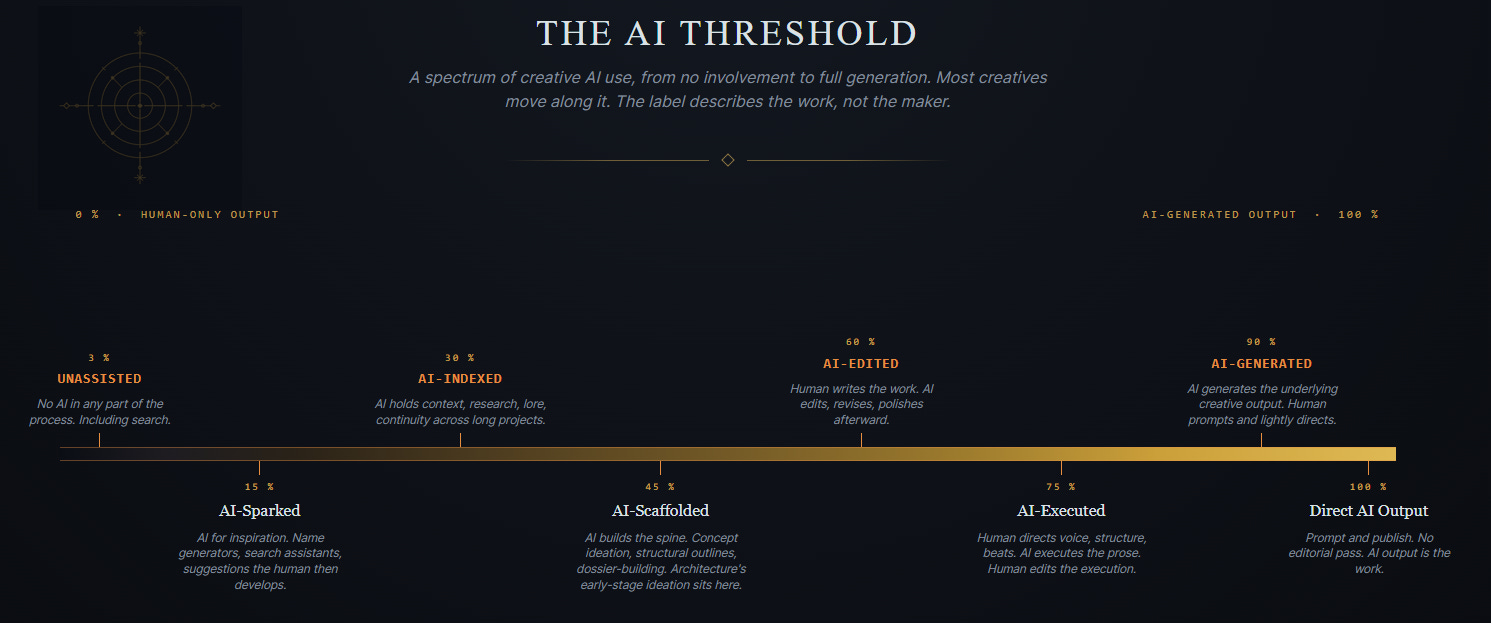
Here are four example ways creatives maybe using AI right now, named as four practices rather than four types of creator. The labels describe the work, not the maker. I’m offering them as a starting point for a vocabulary the conversation still needs to develop. A larger diagram, with intermediate examples marked between the four named here, sits as a companion piece to this essay. The categories are markers along a spectrum, not fixed identities. It is likely most creatives will move between them depending on the work, the day, the project, the energy available.
Unassisted practice. No AI in any part of the creative process. Not autocorrect. Not search engines. Not name generators. Not research tools. The work is human-only from first thought to final penstroke. I respect this position more than the discourse credits it. Unassisted work guards something the rest of society has partially set down: the slow accretion of authenticity through solitary work, the dead-ends, the years it takes for a sentence to become yours. The creators doing this work have decided that holding the line is non-negotiable.
The Unassisted position is also getting harder to hold. Search engines now embed AI by default. Word processors suggest completions. Operating systems integrate AI assistants at the system level. The boundary line moves every year. Unassisted work in 2020 was easier to produce than unassisted work in 2026. By 2030 the position may require active technical refusal: choosing search engines without AI integration, disabling system-level features, opting out at the OS layer. None of that makes the position wrong. It does mean the work requires more effort to hold to the label than it used to.
A working question for unassisted work: did the AI touch any part of the process, including the research and the reference work?
AI-Indexed practice. AI holds context, organises research, tracks structural information across long projects. The creator drives. AI keeps the apparatus around the work clear. For complex projects this is structural and efficient in ways no human assistant could match. AI can hold a fictional universe’s internal consistency across years of drafting, track which character knows what in which book, surface contradictions before they become canon errors. Weeks of research compress into hours. Lore that would otherwise require an obsessive personal wiki maintained by hand becomes searchable.
The AI-Indexed practice also serves accessibility. Working memory differences, dyslexia, ADHD, processing differences of various kinds. For many creatives, indexing work is the cognitive labour that breaks the project. AI-indexed work is not a shortcut. It is an accommodation that makes the larger creative work possible. A novelist with personal memory limitations who uses AI to maintain a continuity bible is doing the same job as a novelist with strong working memory who keeps the bible in their head. The work output is comparable. The path to it is different.
A working question for AI-Indexed work: did you use AI as a research assistant, a continuity tracker, or a name generator, with the actual creative output remaining yours?
AI-Edited practice. The creator writes the work themselves and lets AI do what a paid editor would do if they could afford one. This is one of the more democratising practices on the spectrum. Editorial services are expensive. Good editors are overbooked. A debut novelist with a finished manuscript and no industry money faces a wall: the work needs editing to be query-ready, and they cannot afford editing until the work earns. AI fills the gap, with real limits. It cannot read deeply in a genre. It cannot tell you what a publishable manuscript looks like in the current market. It will give you bad advice from time to time.
The AI-Edited practice also matters for ESL creators, dyslexic creators, creators whose first-pass prose carries the ideas but not yet the polish. AI as editor is the modern version of the patient mentor with a red pen who used to live across the road. The framing that matters is: AI should enable, not replace. Use it to get to the stage where you can afford the human editor. Then pay the human editor.
A working question for AI-Edited work: did the AI revise the prose after you wrote it, with the underlying creative decisions remaining yours?
AI-Generated practice. AI generates the underlying creative output. The creator prompts at the level of write me a fantasy about dragons and ships what arrives, or lightly directs. This is the practice the discourse spends most of its breath on, usually to condemn. The creator is a passenger. They have an idea. AI produces the work.
For some, this is a choice. For others, it is the only way to reach the idea at all. A creator with severe dyslexia, a disabled creator who cannot type for long stretches, a creator with cognitive differences that make sustained drafting prohibitive. For these creators, AI-Generated practice is not a shortcut. It is access. The disability community has been making this argument for years and the AI discourse has mostly ignored it.
This produces a hard problem the labelling argument has to solve. The same point on the AI spectrum, high AI involvement in the output, describes both a content farm/ AI slop operator flooding the zone and a disabled writer expressing ideas they otherwise could not. The output looks similar. The motive is opposite. A disclosure system that flags both identically is honest about the output and silent on the motive. A disclosure system that distinguishes them requires the creator to disclose disability status, which is its own problem.
This is solvable. The solution is probably that disclosure describes the work, not the maker. The reader who cares about authorship gets the threshold information. The reader who cares about the maker’s circumstances can seek that out separately, on the maker’s terms.
A working question for AI-Generated work: did the AI generate the underlying creative output, with you prompting and shipping what came back?
──────── ◇ ────────
Four markers along a spectrum. Most creatives do not sit on one. They move. A novelist might produce AI-Indexed work on a dense project and unassisted work on a love letter. A designer might produce AI-Generated moodboards and AI-Edited client deliverables. A photographer might do unassisted documentary work and AI-Generated advertising mockups. The threshold is something creatives navigate, not something they are.
This is why the argument has been stuck. The discourse treats AI user and non-AI user as identities. They are not identities. They are positions a creator occupies for a particular piece of work. The question is not what kind of creator are you. The question is where on the threshold does this specific output sit.
──────── ◇ ────────
The argument we are having about AI in creativity is wrong. The argument worth having is about consent and disclosure.
Consider what GMO labelling did for food. There are people who refuse GMOs for ethical reasons. There are people who refuse them for health reasons. There are people who do not care. The argument about whether GMOs should exist was unwinnable because the two sides were arguing past each other. What worked was the labelling system. Disclose the modification. Let consumers choose. The argument about whether GMO foods are acceptable stopped being a moral fight and became an informed-consumer question.
The AI conversation needs the same move. Some readers, viewers, listeners, audiences do not want to consume AI-generated or AI-assisted work. That preference is real. It deserves respect, the way dietary preferences deserve respect. Some readers do not care. That preference is also real. The problem is not that the preferences exist. The problem is that audiences currently have no way to make informed choices because the disclosure infrastructure does not exist.
But GMO labelling is binary. AI use is not. GMO is a yes-or-no fact about a seed. AI use is a spectrum from no involvement at any stage through to AI generating the output and the human shipping what came back. A binary AI label cannot carry that information. AI-assisted covers everything from a writer using a search engine that embeds AI to a writer who prompted the entire novel into existence. Those are not the same disclosure.
The labelling system needs to be graduated, not binary. It needs to describe where on the threshold a specific work sits. A reader who sees AI-Indexed for research and continuity; all prose written by the human; AI-Edited for grammar and consistency after drafting gets meaningful information. That reader can make a choice. A reader who sees only AI-assisted gets nothing useful.
This is harder than GMO labelling. It is also more honest. The spectrum exists whether we label it or not. Pretending the question is binary serves the discourse’s appetite for moral hierarchy and serves nobody else.
There is a second problem the labelling system has to solve. The unassisted work produced with a search engine that embeds AI at the platform level. Is that still unassisted? The AI-Indexed work whose word processor offers AI-powered autocomplete that the writer declines a thousand times. Is the declining itself a kind of use? At some point the threshold becomes too fine to label. Practical disclosure will have to set a floor: disclose AI involvement above a certain level of contribution to the work, treat ambient AI infrastructure as below the floor, accept that the system will be imperfect and useful rather than perfect and impossible.
These are problems to solve, not reasons to abandon the project. The food labelling system has these same questions and has been working through them for decades. Organic has a definition. Free-range has a definition. Cage-free has a definition. None of those definitions is perfect. All of them are more useful than no labelling.
What creatives owe each other, and audiences, is the willingness to disclose. The system that emerges will be imperfect. Disclosure is still better than its absence.
──────── ◇ ────────
The series I’m writing rests on a single claim:
Technology is not inherently evil. It is unmanaged. The work in front of us is the management.
This argument is about management, not prohibition.
The argument the discourse keeps having, for AI versus against AI, is the wrong argument because management is not on the ballot. The genie is out. Refusing to engage is a personal choice and not a structural option. The remaining work is figuring out how creatives use AI in a way that keeps the human as the creator. Not the prompter. Not the supervisor. The creator.
Photoshop did not end photography. Photography absorbed Photoshop and remained photography. The digital camera did not end photography either. The discourse around both was loud at the time. RAW versus film. Single-exposure versus composite. Studio versus documentary. The photography world settled into a graduated disclosure system of labels, contexts, and professional standards that honoured the threshold rather than ranking the positions. A composite landscape and a single-exposure portrait are both photography. The audience knows which is which because the disclosure exists.
AutoCAD did not end drafting. The drafting profession absorbed AutoCAD and remained drafting. The threshold moved. New disclosure norms emerged. The work stayed.
Music absorbed sampling, autotune, drum machines, MIDI, software synthesis. Each one was the end of music when it arrived. None of them ended music. Music figured out how to honour the threshold and stayed music.
The four ways creatives are using AI right now are positions along the latest version of the threshold every creative field has navigated before. The argument about whether AI should be used is the argument every previous tool received and was not the argument that mattered. The argument that mattered, every time, was about disclosure. About helping audiences understand what they were consuming. About keeping the human as the creator while the tool absorbed into the practice.
That is the argument worth having. Not whether. How. How not. When. When not. And what we tell the audience about all of it.
──────── ◇ ────────
— AJW
CONTINUITY · A NETWORKED CENTURY The publication runs free.
Threshold infographic at https://continuityconstellation.com/the-ai-threshold.
See more on A.J's substack.
Also published on A. J. Wiadrowski ↗, Continuity Constellation ↗.