The Word That Vanishes As You Say It
Intergrateo Press presents a new fieldnote examining the foundational elements of storytelling. This piece delves into oral tradition and the enduring impact of oral cultures on narrative origins. It considers how memory functions within an oral mind, exploring concepts such as the Homeric and oral-formulaic structures. The essay provides a comprehensive look at the spoken word and its significance before the advent of widespread literacy, setting the stage for understanding the deep history of narrative.
Module 1
Origins: Orality, Epic, and the Deep History of Narrative
The Fieldnotes
These are the long-form Fieldnotes for Module 1 of my storytelling curriculum, one essay per section. Each stands on its own. Read in order, they trace how stories worked as an oral technology, and what that inheritance leaves for a writer working on a silent page.
The seven questions of this module:
What is different about a mind, and a story, with no access to writing at all?
If there is no fixed text, what is the singer doing up there?
What are the building blocks above the formula, and why is there no single right version of the song?
What does writing do to a story, and to thought itself?
Where is a story stored when there are no books, and what if the answer is in the land?
Is the Homeric, oral-formulaic model universal, or one tradition mistaken for all of them?
You write for the page. What survives, and what should you steal, from the oral world?
──────── ◇ ────────
Fieldnote 08: My personal storytelling curriculum.
This is Section 1 of Module 1, on orality and the origins of narrative, and it begins the module where the story itself began, in the world that had no page:
What is different about a mind, and a story, with no access to writing at all?
The first paragraph below is written the way that world would tell it. Then we turn it over and read the machinery.

──────── ◇ ────────
Listen. I will tell you about the time before the page, and it is a hard time and a loud one, and the man who holds it all in his head is a great man, and the man who forgets is nothing. In that time there are no books. There are no books, and there is no writing, and a word is a breath that is gone the moment it leaves the mouth. So the old woman who knows the names of the dead, and the planting and the flood and the law, she is the library, and when she dies the library burns. Listen, because this is how everyone who ever lived knew everything, until, by the species’ clock, yesterday.
Now read it again, because every move it just made is a clue.
That paragraph is additive: and, and, and, clauses laid end to end like beads, never folded into the subordinate “although” and “whereas” that writing taught us. It is redundant, saying there are no books twice, because a listener cannot glance back up a page, so the speaker loops to keep everyone aboard. It is agonistic, staged as a contest between the great man and the nothing, because in a world of speech, words are how you fight and how you praise. It opens by seizing you, “Listen,” because a voice with no page has to hold a body in a room. None of that is bad writing. It is good speaking, and the gap between the two is the subject of this whole module.
Walter Ong built his book Orality and Literacy on one physical fact we forget because we are soaked in text. The spoken word is an event, not a thing. It exists only while it is vanishing. You cannot stop a word and look at it the way you can stop this sentence, because by the time you hear the end of “vanishing” the start of it is already gone. A culture that has never known writing, what Ong calls a culture of primary orality, lives entirely inside that fact. Nothing can be looked up. Nothing can be checked against a record, because there is no record. There is only what someone can say, now, from memory.
Everything else follows. If knowledge cannot be stored on a shelf, it has to be stored in heads, and a head needs help to hold it. So the knowledge that survives in an oral world is the knowledge built to be remembered, shaped into rhythm and wrapped in story, because a list of bare facts evaporates and a story with a shape does not. In a world without writing, you do not know what is true. You know what you can recall. The entire apparatus of oral narrative, the metre and the stock phrase and the refrain, is not decoration. It is the hard drive.
Ong catalogued nine habits of the oral mind, and you met several in the opening paragraph already. Oral thought is additive rather than subordinative, strung together rather than nested. It is aggregative, so things travel in fixed clusters, never the soldier but the brave soldier, never the oak but the sturdy oak, because the cluster is easier to carry than the bare noun. It is copious and redundant, looping back on itself, because forward is the one direction a listener cannot take twice. It is conservative, because knowledge so dearly held in memory is dangerous to change, and the elder who keeps it is honoured over the innovator who risks it. And it stays close to the human lifeworld, storing even abstract knowledge inside concrete human action, because a story about people doing things is rememberable and a table of data is not.
The rest sharpen the picture. Oral cultures are agonistic, full of boasts and riddles and contests, because performance is a public arena. They are participatory rather than distanced, so you stand inside the telling with the teller and not outside it with a critic’s notebook. And they are situational rather than abstract, which the psychologist Alexander Luria showed with unsettling clarity. Working among non-literate villagers in Soviet Uzbekistan, he posed simple syllogisms: in the far north all bears are white, this place is in the far north, so what colour are the bears. His subjects refused the trap. They would not pronounce on bears they had never seen, and answered from the world they knew rather than the formal logic the question wanted, because abstract reasoning detached from a lived situation is a habit writing installs.
None of these traits is safely dead, which is the unsettling part. Sit through a freestyle rap battle and you are watching the agonistic and the formulaic at once, two performers trading prefabricated patterns as weapons, composing under the exact pressure the guslar knew. Listen to a practised preacher build by call-and-response, looping a refrain the room finishes for him, and you are hearing redundancy and participation doing their old work. The wedding vow and the chant on a march run on the same settings. Your own family stories do it too, sanding off the relative who embarrasses the version of yourselves you have agreed to keep. The traits went quiet when the page arrived. They never left the rooms where people still perform to each other in real time.
The most disturbing of the nine is the one Ong calls homeostatic, and it is worth slowing for. Oral memory keeps the past useful, not accurate. A genealogy quietly drops the ancestors who no longer matter and keeps the ones who justify who holds power now. A word whose thing has vanished from life falls out of the language, with no dictionary to preserve its corpse. The society keeps its memory in balance with present need, editing the past continuously and invisibly, and there is no older version on a shelf to catch it doing so. An accurate story, faithful to a fixed record, is a literate idea. The oral past is kept in tune with the present rather than checked against a record.
You can watch the homeostatic edit happen. Anthropologists studying oral genealogies have found family trees that stay a fixed depth no matter how many years pass, the founding ancestors and the living generation both kept while the unimportant middle quietly evaporates, because a genealogy in an oral world is not a record of the past but a charter for the present, kept exactly as long as it stays useful. There is no archive beneath it to consult, so there is nothing for it to be wrong against. The past is not being remembered badly; it is being maintained. Literacy is what made accuracy even thinkable, by setting a fixed text beside memory and letting the two disagree.
Notice what this means. The oral mind is not our mind minus writing, a runner with a leg missing. It is a different machine, tuned for a different job, and at that job it beats us without effort. It can hold a genealogy forty generations deep, an epic of thousands of lines, the whole pharmacology and law and navigation of a people, in working memory, performed on demand. We outsourced all of that to the page and the search bar, and in the trade we lost the muscle. When you finish this module you will not envy them their world, but you will stop mistaking their technology for the absence of yours.
The next section goes inside the machine to watch one part work, the formula, and answers a question that has puzzled readers of Homer for centuries: why Achilles is called swift-footed even while he sits still.
Your task: take a transcript of unscripted talk, a podcast or an interview or a recorded family story, and hunt Ong’s traits in it. Find where it adds instead of subordinating, where it loops back to keep you aboard, where it turns a plain fact into a small combat. The traits did not die with writing. They went quiet, and they still run under every story told aloud, including the ones you tell.
──────── ◇ ────────
Further reading for this section:
Walter Ong, Orality and Literacy, especially chapter three on the psychodynamics of orality.
John Miles Foley, How to Read an Oral Poem, for a clear and humane orientation to the whole field.
──────── ◇ ────────
- AJW
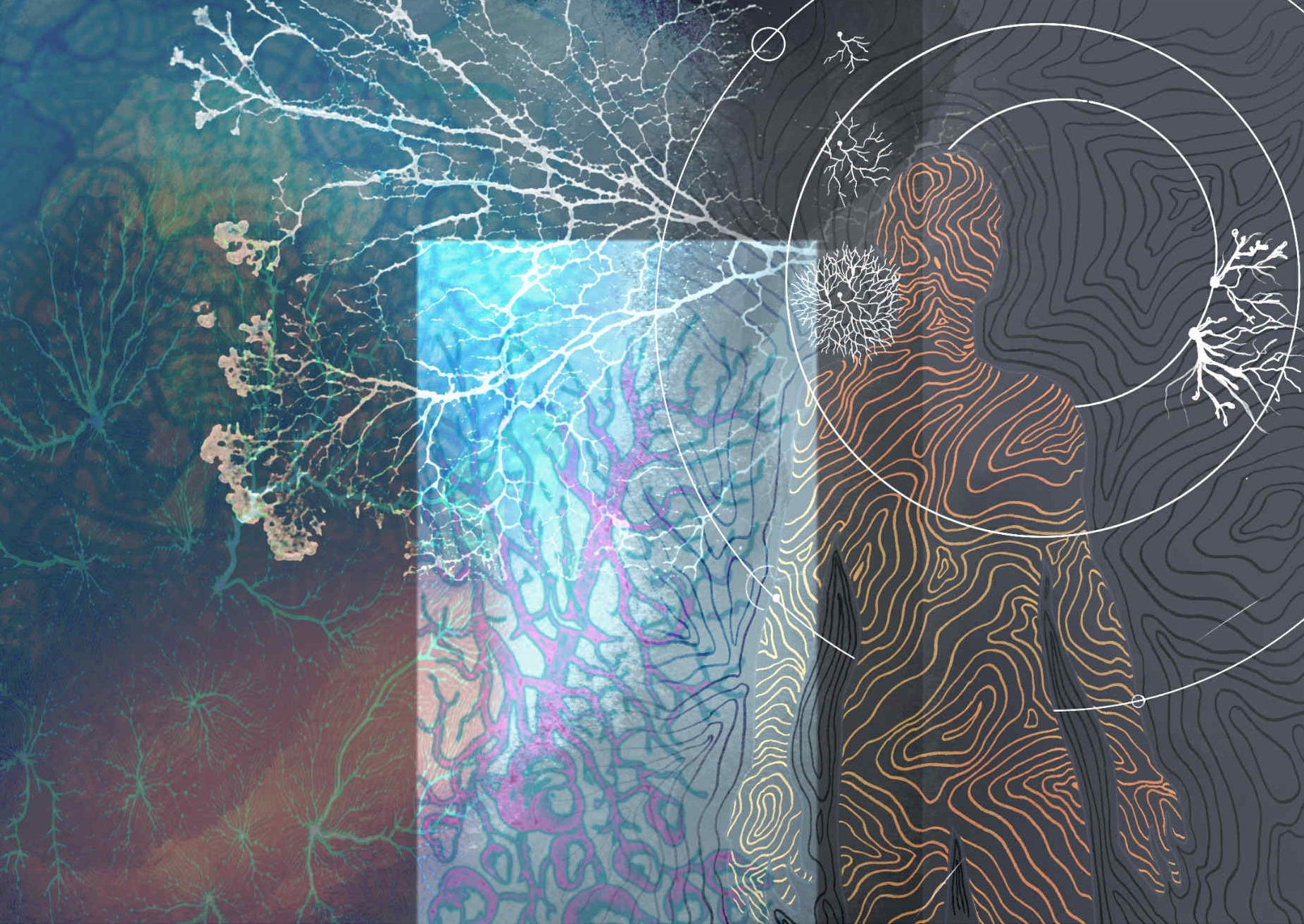
The concept cover for my upcoming novel - The Grey Corner, Book 2 of the Continuity Constellation.
Art by Saturnids Art Link: https://mushroomy.house/collections/saturnids
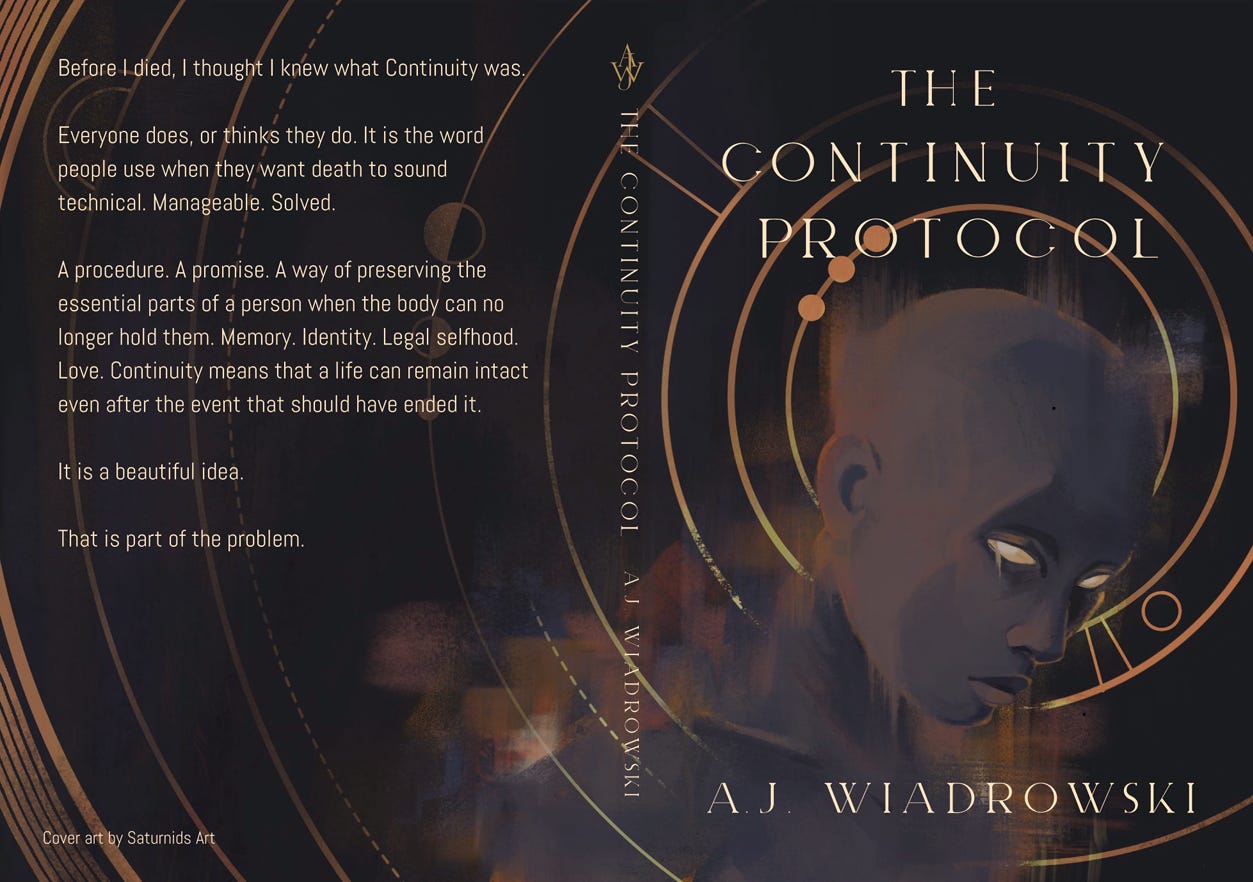
Book 1 of the Continuity Constellation: The Continuity Protocol available on Amazon and indie publishers
This fieldnote contributes significantly to our understanding of narrative theory and cultural history, offering insights relevant to contemporary storytelling curriculum. By exploring the cognitive science behind oral cultures, the essay encourages a re-evaluation of how stories are constructed and perceived. It highlights the critical work of scholars like Walter Ong, whose concepts of orality and literacy remain central to appreciating the dynamic nature of the spoken word.
Also published on A. J. Wiadrowski ↗.
Originally published at continuityconstellation.substack.com ↗