Swift-Footed Achilles Is Sitting Down
Intergrateo Press presents a fieldnote exploring the deep history of narrative and the oral tradition. This essay, drawn from a comprehensive storytelling curriculum, delves into the mechanics of ancient narrative, particularly Homeric epic. It examines how oral-formulaic theory, championed by scholars like Milman Parry and Albert Lord, reveals the intricate processes of composition in performance. The Press is pleased to share this contribution to understanding the foundations of epic poetry and storytelling curriculum development.
Module 1
Origins: Orality, Epic, and the Deep History of Narrative
The Fieldnotes
These are the long-form Fieldnotes for Module 1 of my storytelling curriculum, one essay per section. Each stands on its own. Read in order, they trace how stories worked as an oral technology, and what that inheritance leaves for a writer working on a silent page.
The seven questions of this module:
What is different about a mind, and a story, with no access to writing at all?
If there is no fixed text, what is the singer doing up there?
What are the building blocks above the formula, and why is there no single right version of the song?
What does writing do to a story, and to thought itself?
Where is a story stored when there are no books, and what if the answer is in the land?
Is the Homeric, oral-formulaic model universal, or one tradition mistaken for all of them?
You write for the page. What survives, and what should you steal, from the oral world?
──────── ◇ ────────
Fieldnote 09: My personal storytelling curriculum.
This is Section 2 of Module 1, and it solves a small mystery that opens onto a large one:
If there is no fixed text, what is the singer doing up there?

──────── ◇ ────────
Open the Iliad at any page and the same phrases keep coming. Dawn is rosy-fingered every single morning. The sea is wine-dark whenever it is named. And Achilles is swift-footed, the fastest man at Troy, even through the long stretches where he is doing nothing faster than sulking in his tent. A modern editor would cut it. Why call a man swift-footed while he sits? Why report the colour of Dawn’s fingers three hundred times? For a long while readers filed this under the conventions of old poetry and moved on. The truth underneath is one of the great discoveries about how stories are made.
In the 1920s a young classicist named Milman Parry looked hard at those repeated phrases and noticed what no one had. They are not chosen for meaning. They are chosen for metre. Homeric verse runs in a strict six-beat line, and that line has slots of a particular shape that have to be filled. “Swift-footed Achilles” is not a remark on what Achilles is doing. It is a block of sound, the exact size and rhythm to fill the end of a line when the hero’s name is wanted there. When a different metrical space opens, a different tag for Achilles drops into it. The epithet is a prefabricated part, selected to fit the gap in the line, not the moment in the story.
Parry showed the system was astonishingly tidy. For a common idea, like the hero in this slot or the ship in that one, a tradition kept one ready-made phrase of each needed metrical shape, and rarely a second that did the same job, because a duplicate would be dead weight in a memory already carrying thousands of lines. He called this the economy of the system, and its reach its scope. Together they describe not a poet decorating his lines but a craftsman with a full set of standard parts, one for every recurring need, each cut to fit the metre exactly.
Make it concrete. A line of this verse ends on a fixed rhythmic cadence, and the name of Achilles has to be dressed to fill whatever room is left once the rest of the line is laid down. A long gap at the end of the line takes “swift-footed Achilles.” A shorter gap takes a shorter tag. A line that must open on his name reaches for a different formula again. The singer is not hunting the most fitting adjective for the moment; he is reaching for the block of the right size, the way a mason takes the stone that fits the gap without breaking the rhythm of his laying. Whatever meaning the stone carries comes along for the ride. Lattimore, rare among translators, keeps these joins visible instead of smoothing them flat, which is why the course points you to him.
Once you see it, the puzzle inverts. The repeated epithet is not laziness but the visible trace of the hardest thing a performer can do: compose poetry out loud, in strict metre, at speaking speed, with no chance to pause or go back. Try it. Try inventing a single line of correct rhythm with the next already bearing down, and you understand why a singer needs prefabricated blocks. The formula buys him the half-second to think ahead. While his mouth lays down “swift-footed Achilles,” a phrase his hands know in the dark, his mind is already reaching for the next event. The tags are not what he is saying but the rhythm section that lets him keep playing while he thinks.
One misreading is worth killing. The repeated formula is not a poverty of invention, the way a worn modern phrase is, but a structural, load-bearing part of a system that has no written alternative, doing work at speed that no freshly minted phrase could. The parts the singer never has to invent are exactly what free him to invent the rest. Read the repetition as decoration and you have mistaken the scaffolding for the building. Strip the formulas out to make the poem original and you do not get a better poem; you get a poet who can no longer sing.
Parry could have left it as a theory about a dead poet. Instead he did the thing a literary scholar seldom does. He went to find it alive. In the 1930s he travelled to the mountains of what was then Yugoslavia, where illiterate singers, the guslari, still sang long heroic epics in performance, accompanying themselves on a one-string fiddle called the gusle. With heavy recording gear he captured them by the hour. And there it all was, in living men: the formula system, the metrical slotting, songs of thousands of lines built on the fly. He had found, breathing, the technique that produced the Iliad three thousand years before. The proof of how Homer worked turned up not in a library but in a coffeehouse in Novi Pazar.
His student Albert Lord finished the work in a book called The Singer of Tales, and its central finding overturns what most of us assume a bard is doing. The singer does not memorise a fixed poem and recite it. There is no fixed poem to memorise. What he has learned is a technique, a deep stock of formulas and themes, and from that stock he re-makes the song every time he sings it. Lord noticed that if you asked a singer whether he could repeat a song exactly, word for word, he would say yes. Then you recorded him twice and found the two versions differing in hundreds of details while he insisted, sincerely, that they were the same song. For him “the same” meant the same story, the same essential shape. Identical words, a verbatim text, did not exist in his world, because verbatim is a thing only writing can hold.
Lord also watched how a singer is made, and it looks nothing like memorising. A boy first sits and listens for years, soaking the stories and the rhythm without performing. Then he begins to apply the technique, singing roughly, stitching together formulas he only half controls. Only later does he sing fluently, and by then he is not reciting anything at all but composing, at speed, inside a tradition so deep it feels to him like memory. Ask such a singer who made the song and the question barely lands. The author of an oral epic is not a person. It is a technique with a thousand-year head start, wearing a singer for the evening.
So return to Achilles, sitting in his tent, still called swift-footed. That phrase is a fingerprint. It is the seam where real-time composition shows through, the mark of a mouth keeping metre while a mind worked ahead, frozen in place on the day the tradition was finally written down. What a careless editor would strike as a flaw is the best evidence we have of how the poem was truly born. The mistake is the proof.
This also quietly settles a question that consumed classical scholars for two centuries, the Homeric Question: was there one poet named Homer or many, and how could a single unlettered man have built poems this long and this fine? Scholars had split into camps, the unitarians who wanted one genius and the analysts who wanted a committee of editors, and both were asking a literate question of an oral object. Parry dissolved the question rather than answering it. The poems were composed the way the guslari composed, live, by a master working a traditional craft, and the name Homer is best read as what we call that tradition at its height. The genius is real; it is only not the lonely genius at a desk we had pictured.
The formula is the smallest part. Above it sit larger ready-made blocks, whole scenes a singer can deploy and resize at will, and that is where the next section goes.
Your task, the one Module 1 task that also counts toward the course total: take a passage of Homer, Lattimore’s translation keeps the formulas best, and mark every repeated epithet and set phrase. For each, ask the performer’s question rather than the reader’s. What is this doing for someone composing aloud, in metre, with no time to stop?
──────── ◇ ────────
Further reading for this section:
Albert Lord, The Singer of Tales, chapters one to three.
Milman Parry’s own work, collected in The Making of Homeric Verse, especially the essay on the traditional epithet, where the metre-not-meaning discovery is laid out.
──────── ◇ ────────
- AJW

The concept cover for my upcoming novel - The Grey Corner, Book 2 of the Continuity Constellation.
Art by Saturnids Art Link: https://mushroomy.house/collections/saturnids
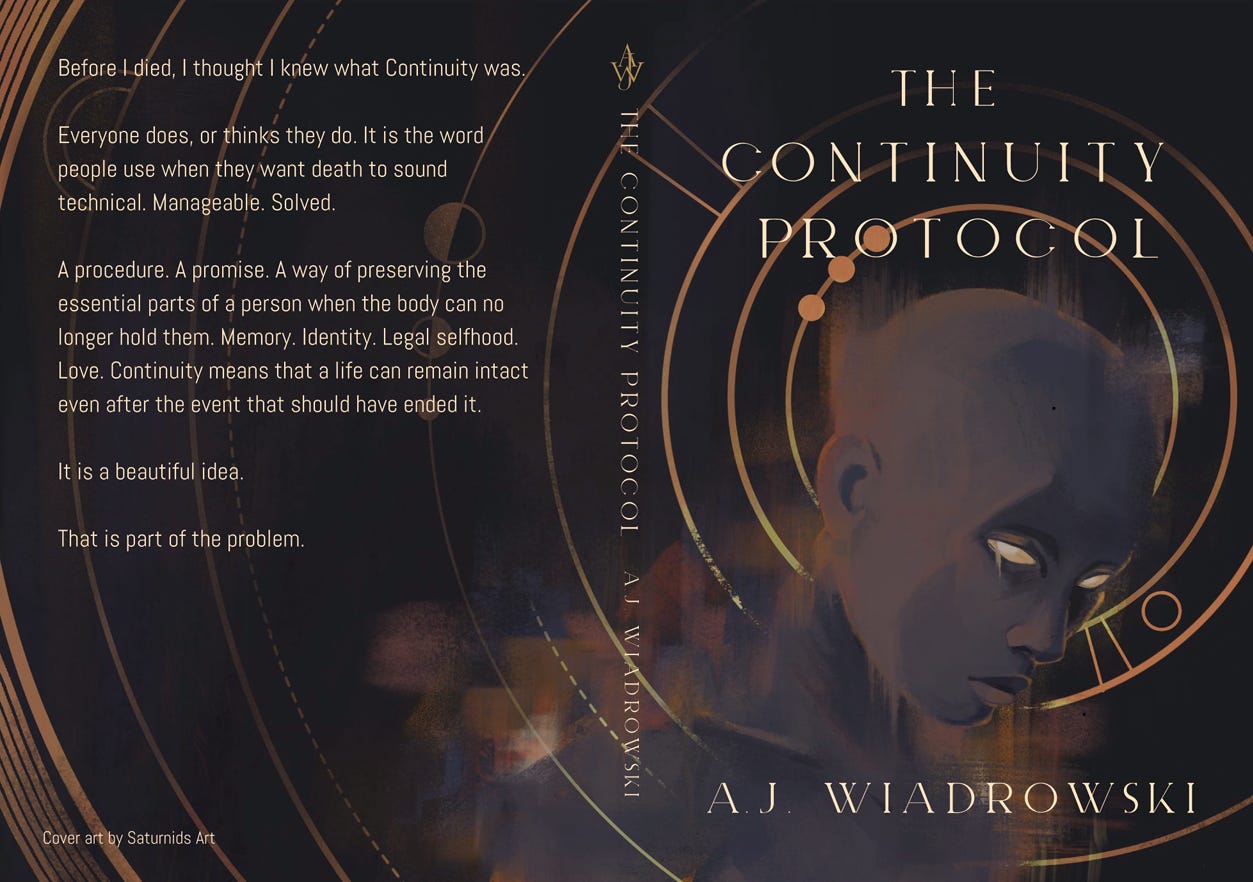
Book 1 of the Continuity Constellation: The Continuity Protocol available on Amazon and indie publishers
This fieldnote offers a compelling look at how epic poetry was constructed within an oral tradition, moving beyond superficial readings of epithets like "swift-footed Achilles." It underscores the enduring relevance of ancient narrative practices, providing insights into a storytelling curriculum that bridges historical understanding with contemporary writing. The Press believes this piece enriches the discourse on literary theory and the profound legacy of oral composition.
Also published on A. J. Wiadrowski ↗.
Originally published at continuityconstellation.substack.com ↗