Edison’s Candle: An AI Allegory
Intergrateo Press presents A. J. Wiadrowski's essay, "Edison's Candle: An AI Allegory," offering a timely exploration of artificial intelligence within creative industries. This piece delves into the evolving landscape of content creation, examining the impact of AI tools on authorship and the broader creative economy. Wiadrowski investigates the ethical considerations arising from the widespread adoption of AI content, questioning how human craft maintains its value amidst technological advancements and the implications for digital art and writing processes. This essay provides a vital contribution to contemporary discussions on technology's influence.
WORKSHOP · ESSAY 02
A. J. Wiadrowski · 26 May 2026
There is a structure forming in creative work right now. AI floods the free tier. Human craft retreats behind paywalls. The readers who can pay get the human work. The readers who cannot pay get the AI version.
Stock photography is already there. Commercial illustration is most of the way there. Music production is close. Writing is following.
The line for it, the one I cannot stop thinking about, is by Thomas Edison:
“We will make electricity so cheap that only the rich will burn candles.”
I would, however, dare to venture an update to this quote for the AI age:
“We will make content so cheap to create, that we will drive up the value of human creativity.”
Cheap convenience at the bottom, expensive humanity at the top. The market sorts the rest.
I am on both sides of that line.
──────── ◇ ────────
I argued two weeks ago that the AI conversation needs graduated disclosure, not a binary moral label. Four practices along a threshold. The argument worth having is about consent and transparency, the way GMO labelling moved a stalled moral fight into informed-consumer territory.
There is a deeper argument underneath that one. The disclosure essay assumed a discourse acting in good faith. The wallet vote is the test of whether the discourse means what it says.
This week I am the example. The essay arguing for more sophistication around AI disclosure should be followed by the disclosure.
──────── ◇ ────────
I grew up on the Sunshine Coast. “Country” Queensland. Sunshine Coast is not real country, but it is for most people.
I grew up in Golden Circle pineapple country. My grandfather and I built a trebuchet to launch their rejected pineapples back at them in the middle of the night, because my grandad was convinced it would confuse the chickens. Then again, he also warned me about putting the bathwater in upside down.
When I was close to 28 I moved to Naarm (Melbourne, Australia for those who don’t know). Got an MBA in my late twenties. Got a diagnosis a few years after that. ADHD and dyslexia, late, which is the order most adults like me find out.
I learned to identify the difference between you’re and your in my twenties, after my first university graduation. I had known for years that a difference existed.
The reader who has dyslexia knows what that means. For everyone else: I was reading, writing, and getting graded on assignments knowing there was a difference between those two homophones, but unable to identify them visually as different. I was producing acceptable-enough work by pattern-matching and bluffing.
I finished my master’s thesis in less than a week after six months of procrastination. I’m not proud of it but it did affirm to me ‘never trust a statistic’. I passed. Just above the lowest mark on the pass scale, most likely the marker wanted to fail me and decided not to.
I do not condone the way I got there. It does, however, explain the way I work. I can produce good enough very fast, and the good enough is a botch job that needs intervention before it goes anywhere. AI is one form that intervention takes. The other is one of my closest friends. She is married to one of my groomsmen. She does the deeper read after the spellcheck, Grammarly and other AI assisted systems, and the relationship is structured that way on purpose.
──────── ◇ ────────
The picture I am painting uses four tiers, and they sit on top of the spectrum from the last essay. The difference is that these are about commitment, not practice. What has the writer actually committed to, and how does the commitment land on the page.
Certified AI-free. Completely analogue. Pen on paper. Typewriter. Word processor with every AI feature disabled. Search engines without AI integration. No autocorrect, no spell-check, no suggestions. The work exists without AI having touched any part of it. It is the only tier where no AI is literally true. I do not produce work at this tier. The writers who do are guarding something the rest of us have set down, and they deserve the specific label rather than being collapsed into the next one.
AI-free. AI may suggest. The writer approves or denies each change before it is applied. AI never inserts. Every word on the page passed through a human decision. The novels are here. The Serial Port is here.
This tier has layers. Grammarly is the entry point. Spellcheck. The Microsoft Office squiggle. Throwing a sentence into a search engine to check whether the right word is in fact the right word. I do all of these. Most writers do, including most of the writers currently arguing against AI involvement in writing. The label has to be honest about that. AI-free does not mean the writer worked without any tool. It means every change passed through a human decision before it touched the page.
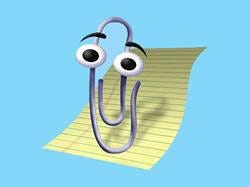
Figure 7. Clippy, c. 1997. The Microsoft Office Assistant. The lineage the current AI-suggestion-and-approve tier runs back to.
Contains traces of AI. More than suggestion. AI was in the loop while the writing happened. Drafting alongside. Structuring with. Language coming back from a prompt and getting shaped by hand. The idea is mine. The flow is mine. The argument is mine. The final voice is mine. AI contributed material I then made my own. Every decision is mine. The work would not exist in its current shape without the loop.
This essay sits here. The disclosure is at the top.
The threshold between AI-free and contains traces of AI is the threshold between AI as suggestion-tool and AI as drafting partner. Both are mine. The labels distinguish how mine.
AI-generated. AI produced the underlying output. The creator prompted and shipped what came back, or lightly directed. The cover placeholders on the publication. The podcast voice. The code for the Atlas of Horror tool. Each one disclosed at the artefact, like the caption under Figure 1.
──────── ◇ ────────
Where each part of the publication sits.
The covers are being made by an artist friend. @saturnids on Instagram, mush.house/saturnids. Royalty share for life. The AI placeholders buy time until their covers exist, and they protect the artist’s process from being rushed for the sake of a publication schedule. Figure 3, Figure 4, Figure 5.
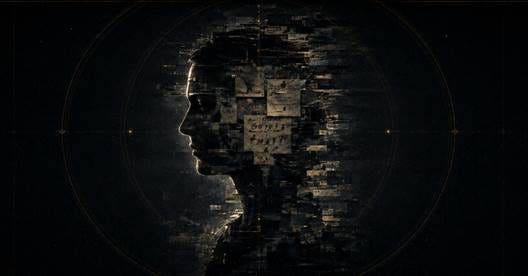
Figure 3. The AI-generated hero image on Welcome To The Serial Port, with its disclosure caption: AI placeholder, edited by me directly, pending the human-made cover.
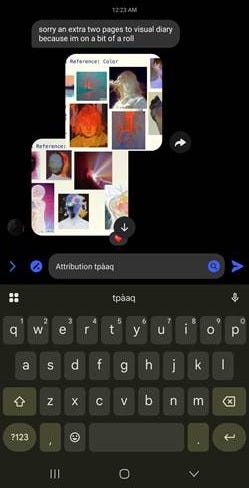
Figure 4. Reference boards for the Continuity Constellation covers. Colour reference and concept reference, sent with the message: “sorry an extra two pages to visual diary because im on a bit of a roll.”
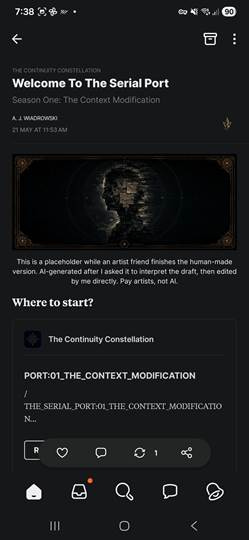
Figure 5. The published post, Welcome To The Serial Port, with the AI placeholder image and its disclosure caption.
The podcast voice is AI. I wrote it. I spoke it. I had it regenerated as a femme voice. I missed the disclosure on the first episode because I was not sure I was publishing the poem until the last minute. The disclosure is here now. It will be on the next episode at the top of the show notes. The voice is a placeholder until a friend who can voice act and wants a royalty cut takes the chair.
The editorial pass on the novels is one of my best friends. Handwritten notes across five pages. Figures 6a and 6b. AI cannot do the personal sign-off at the bottom of page four. It can produce a sentence shaped like encouragement. It cannot have watched me across drafts. It cannot mean it.
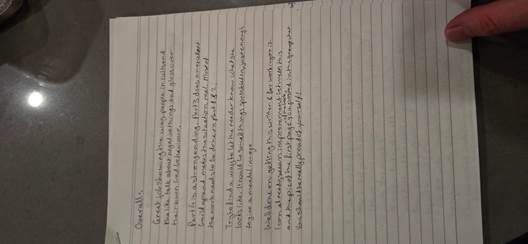
Figure 6a. Editorial notes, page 1. Format observations, suggested reference text, structural questions about part counts and pacing.
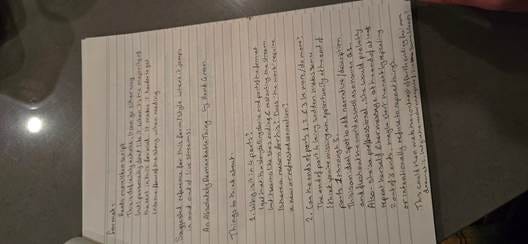
Figure 6b. Editorial notes, page 5. Continuation of structural reading on later parts.
──────── ◇ ────────
Here is how I am betting.
This publication runs free. The first thousand subscribers are free for life. After a thousand, the paid tier opens. Paid will charge for AI-free work: the novels and the serial. Free will keep running with the contains traces of AI essays and the workshop track alongside it.
The wallet vote, when it comes, will tell me whether the bet was right.
──────── ◇ ────────
The argument I want to leave you with is this. AI is not killing the creative industries. AI is the chaotic phase before human-made work becomes worth what it should always have been worth.
For the last twenty years, the structural pressure on creative work has been downward. Stock photography destroyed photographer day rates. Commercial illustration got squeezed by global freelance platforms. Musicians stream for fractions of cents. Writers chase content rates that have not moved since 2010. The story the discourse told about creative work was that it was being devalued by abundance and that the abundance was permanent.
AI accelerates the abundance to its logical end. When anyone can generate stock photography, commercial illustration, background music, and acceptable-enough prose for the price of an API call, the floor of the market drops out. The work that lives at the floor is now free. The work that lives above the floor finally has somewhere to stand.
That is the bet. AI does not kill creative work. AI kills the bottom tier of paid creative work, the tier that was killing creative work anyway. What it leaves behind is a market that finally has to pay for the thing only humans can do, because the thing only humans can do is the only thing that is not free.
Edison built the electricity grid so light could exist for everyone. The candle did not disappear when electricity arrived. The candle became something else. A luxury. A ritual. A choice. A gift. Something you pay for when you want to mark that this moment is different from the moments lit by switches.
Human-made creative work, after AI, is the candle.
I am on both sides of that line because everyone is. I use AI as the electricity. I make the candle. The labels and the disclosure are how the reader can tell which is which, because if the reader cannot tell, neither half of the market works.
If we get the disclosure right, the candle stops being undersold. The artist friend doing the covers gets paid more, not less. The voice actor who eventually takes the podcast chair gets royalty share, not minimum wage. The novelist with dyslexia and the novelist without and the novelist in the wheelchair and the novelist working in pen on paper all get to charge what the work is worth, because the work is no longer competing against an infinite supply of cheap.
The wallet vote, when it comes, will tell us whether we got the disclosure right.
Until then, the publication runs free, the disclosure is the work, and I am one creator showing his.
— AJW
CONTINUITY · A NETWORKED CENTURY The publication runs free.
Concluding, Wiadrowski’s "Edison’s Candle: An AI Allegory" challenges readers to reconsider the economic and ethical frameworks surrounding AI content and human craft. This essay underscores the necessity for transparent AI disclosure and thoughtful engagement with new content creation paradigms. It serves as a significant commentary on the future of creative work, prompting further dialogue on digital ethics and the enduring value of human ingenuity in an increasingly automated world. Intergrateo Press is pleased to share this thought-provoking analysis.
Also published on A. J. Wiadrowski ↗, Continuity Constellation ↗.
Originally published at continuityconstellation.substack.com ↗