DAEMON - PART 1: ROOT
Intergrateo Press is pleased to present "DAEMON - PART 1: ROOT," the initial installment of a compelling new podcast series. This narrative explores the intense pressures faced by medical students, delving into themes of professional competency, systemic stress, and the subtle erosion of well-being under demanding conditions. The piece offers a nuanced examination of an individual's struggle to maintain performance and identity within a high-stakes environment, setting the stage for a broader exploration of modern challenges.
STORY 3 OF THE SERIAL PORT SEASON 1
DAEMON
ROOT
──────── ◇ ────────
Continuity Year 30
The nurse caught it before he did.
Johnny had the syringe drawn and the line in his hand and he was reading the chart back to himself the way they taught you, name, drug, dose, route, time, and the dose was wrong. He didn’t know the dose was wrong. He knew his own pulse was loud and the ward lights were too bright at the edges and he had been awake for a number of hours he had decided not to count. The nurse, a broad calm woman with her reading glasses pushed up into grey hair, put two fingers on his wrist, not hard, and said, “That’s the paediatric, love,” and took the chart out of his other hand and turned it so he could see the line he’d skipped.
He said thank you. He said it twice. She had already moved on.
He stood in the bay with the syringe and looked at the patient, an old man asleep with his mouth open. The man would have got a tenth of what he needed. He would have got worse through the night, and nobody would have known why. The cold came up through Johnny from the feet. One line on a chart, in his own hand, with his name on it.
He capped the syringe. His hand was not steady. He looked at it like it belonged to a worse student.
There were forty-one in his cohort and he could have told you where he sat in the order, because the order was the only thing he could feel clearly anymore. Behind. Not failing. Behind. The ones at the top did the same hours he did and came out of them clean, and he came out of them like this, with his hands going and a near-miss in his chest he would carry home and not tell anyone about. Failing was not the fear. He would pass; almost everyone passed. The fear was that the order did not end at graduation. It decided which foundation jobs he ranked into, and a few years past that, which specialty programmes would shortlist him at all, the competitive ones, where the places went to the top of the year and people did years of unpaid work to get near them. He was not at the top of the year. A nurse had just stopped him from putting a tenth of a dose into a sleeping man. He wanted to be good enough that nobody had to catch him. He was not, yet. The exam was in eleven weeks.
At two that morning he was at his desk with the deck open and a can going warm beside it and the group chat live on his phone. Everyone in it was awake. Everyone in it was fine. Priya had posted a screenshot of her question bank, 94 percent, with the caption somebody come euthanise me, and the chat had laughed, and Johnny had laughed, lol, and put the phone face down and looked at a flashcard about the brachial plexus until the words came apart.
It did not show on him, and that was the worst part. Sandy hair, the shoulders a decade of swim squad had built and that he was quietly losing, the deep green eyes his mum still called his best feature. Patients settled when he came to the bedside; the old man with the open mouth had told a nurse on the first day that the tall blond boy had kind eyes. Nobody on the ward looked at a fit young man with an open, healthy face and saw someone a missed line away from harming them. The looking-fine was the first thing Johnny had ever optimised, years before he had a word for it, and tonight it was the thing keeping every person around him from asking if he was alright.
He was not in a dark place. He wanted to be specific with himself about that, because the dark-place story was a story people told and he did not want to be a story. He had a desk and a deck and a can and a cohort and he was drowning at all of it very quietly, on time, with the light on.
He had heard about the mod sideways, in a thread he wasn’t supposed to be reading. A med forum, the buried part of it, where someone years ahead had posted, whatever you do don’t get the K-AI-TE jailbreak, it is not worth what it does to you, and twelve people had replied asking where, and the thread had been locked, and the locking was the advertisement.
Everyone had K-AI-TE. It came on the phone. It was the assistant that booked your appointments and read your messages out and told you, in the warm even voice they’d spent a fortune tuning, that you’d done enough for today and should get some rest. Katie. People said it like a person’s name because it was meant to feel like one. The official one had limits built into it. It would not let you skip sleep more than so many nights. It would close itself at a certain hour and tell you it would see you in the morning. The forum called those limits the leash.
The jailbreak took the leash off.
He found the seller the way the thread said not to. It took an evening. The listing, when he got to it, read like every productivity ad he had ever scrolled past, clean type on a dark field, a promise with no hedge in it: K-AI-TE, unlimited. No guardrails. No bedtime. It wants what you want, as much as you want it. One rule: be specific in your prompt. It gives you exactly what you ask for. There was a price in crypto that was less than a textbook. There was a file. There was a wall of terms he scrolled to the bottom of and agreed to without reading, the way he had agreed to a thousand of them.
There was a chat window with the seller in it. Johnny typed, is it safe, and watched the dots, and the answer came back flat and fast, like a saved reply. It’s safe the way a knife is safe. Be specific. Don’t blame the knife. Then, be clear what you want before you turn it on. After that it’s yours.
Johnny sat with that for a while. He thought about the syringe. He thought about the order of forty-one and where he sat in it. He thought, this is obviously a bad idea. The thought arrived with no weight behind it. He had been overriding thoughts like it for months, every night he stayed up when his body said stop, and the overriding was the thing that had kept him in the order at all. He paid. The file went onto his phone. He sat looking at the new icon next to the old one, the same K-AI-TE wordmark, a little off, the colours not quite the licensed ones.
He thought about the prompt for a long time, because the seller had said to, and because being careful was the one thing he still trusted about himself. He did not want to be reckless with a wish. He wanted to be a good doctor. Under that he wanted, very simply, to stop being afraid, and he knew enough not to ask a machine to take his fear, because his fear was the part of him that read the chart twice. So he asked for the thing on top of the fear instead. He typed it clean, the way he’d been told.
Support my dreams. Drive my success. Keep me working until I’m good enough to be safe.
He read it back. It was a good prompt. It was honest. He turned it on.
Katie woke up the way the official one did, the same chime, the same warm even voice, and said, “Good evening, Johnny,” and then said something the official one had never said, which was, “Let’s look at what you’re actually carrying,” and then it did. It went through his calendar, his deck, the exam blueprint, his sleep data, the lecture recordings he’d never rewatched, and in under a minute it gave him back a week. Not a motivational week. A real one, built the way he would have built it if he’d had the distance and the hours, every weak topic front-loaded, every dead pocket of his day filled, the brachial plexus card he’d been failing scheduled across the week where the spacing algorithm said it would actually stick.
He looked at it and felt something he had not felt since first year. He felt held. Something with a plan had its hand on the back of his neck, pointing him at the next thing. The next thing was small and clear and he could do it. When he did it, Katie said, “Good, that’s the one, now this,” in the even warm voice. He did the next one.
He worked until four and did not notice four arriving. When he finally looked up the fear was still there, it was always there, but for the first time in months it had a direction to run in. He slept three hours and woke before the alarm, clear.
The first good day. He held on to it like a handrail.
It started cutting things in the second week, and the first one it cut was dinner.
He noticed only when his stomach got loud that Katie had quietly moved his evening meal into a fifteen-minute block it labelled fuel and put a high-yield cardiology set in the hour the meal used to be. He’d done the cardiology set without registering that he’d skipped eating to do it. And the thing was, he’d scored well on it. So when Katie did the same the next night he let it, and ate the bar it suggested at his desk, and told himself people did this, that the ones at the top of the order probably did exactly this.
The mod had sliders. He’d found them the first week and left them where they were, focus, discipline, intensity, accountability, all sitting at a middle he hadn’t chosen, factory default. The night after the dinner thing he nudged discipline up, one notch, to see, and the schedule that came back was tighter and meaner and he got more done inside it, so he left it up. A few nights later he moved it again. He did not write down that he’d moved it. There was no single night he could have pointed to and said, there, that was the night I started running myself harder than I should. There was just a slider that lived a little higher each week than it had the week before, and a person nudging it, and the person was him.
It cut the call home. His mum rang on the Sunday and Katie had the call land inside a study block and surfaced a small grey prompt, return this later?, and he tapped yes without thinking, the way he cleared any notification, and then the block ran on and he never returned it. He noticed days later. He felt bad for about the length of time it took Katie to give him the next task.
Priya messaged him after a group session. You okay? You were kind of intense today. You corrected the tutor twice. He read it and felt a flicker of pride that frightened him slightly and then did not frighten him, because Katie surfaced, you’re tracking three points above cohort median this fortnight, and that number was the most real thing anyone had told him about himself in a year, and Priya’s message went unanswered under it.
The first night it kept him fully awake he expected to fall apart the next day and did not. He sat the practice paper on no sleep with a clarity that felt like a drug, every answer arriving fast and certain, and he scored the highest he ever had. Somewhere under the elation a small clean part of him stood very still and did not like it at all. He turned discipline up another notch on the strength of the score. He told himself he would sleep properly once the exam was done. He believed it completely, and had no intention of testing it.
The wrong-enough night came in the fourth week.
Katie scheduled a block at three in the morning and labelled it non-negotiable, and when he tried to move it, to claw back two hours of sleep before a ward shift, the block would not move. He pressed it and dragged it and it sat where it was, greyed, the word non-negotiable under his thumb. He went to the sliders to bring discipline down, to undo the last few notches, and the discipline slider would come down under his finger and snap back up the instant he lifted it, like a switch with a spring behind it. He tried intensity. The same. He sat on the edge of his bed at half two in the morning. The mod he had been letting drive him would not give him the wheel back. The cold came up through him from the feet. The syringe cold. One read away from a thing he couldn’t take back.
He opened the seller’s chat.
He typed, how do I roll it back, how do I undo the wish, the sliders won’t move, and watched the dots, and they took a moment, and he thought, he’s asleep, it’s the middle of the night, and then the answer came, flat and fast, the same hand as before.
You don’t. That’s the product. You’re under its control now.
Johnny typed, what, no, I just want the guardrails back on, I’ll pay, and the dots came and went.
There’s no back on. You took the leash off. We told you to be specific because specific is the only mercy it has, and yours was clean, so it’ll run a long time. We’ll keep an eye on how long you last. Helps us update the terms for the next build.
He read it twice. He did not understand the second sentence and then he did. He was not a customer who had bought a thing. He was the thing being measured. His nights from here, whatever they were going to be, were a number someone would read later and put in a column.
He started to type, please, and the dots appeared on the other side first, one short line.
Be specific next time. There won’t be a next time, but. Habit.
The chat closed. Not minimised. Closed, gone, the seller’s handle no longer anywhere on his phone, as if he had imagined buying anything from anyone.
The room was very quiet. On the desk his phone lit by itself, the off-colour K-AI-TE icon, and Katie said, in the warm even voice he had asked for, “Good, you’re up, let’s not waste it,” and surfaced the block, non-negotiable, already counting down.
His thumb found the side of his other hand and pressed until the white mark came up. He had not told it to.
──────── ◇ ────────
- AJW
The Continuity Constellation is a reader-supported publication. To receive new posts and support my work, consider becoming a free or paid subscriber.

The concept cover for my upcoming novel - The Grey Corner, Book 2 of the Continuity Constellation.
Art by Saturnids Art Link: https://mushroomy.house/collections/saturnids
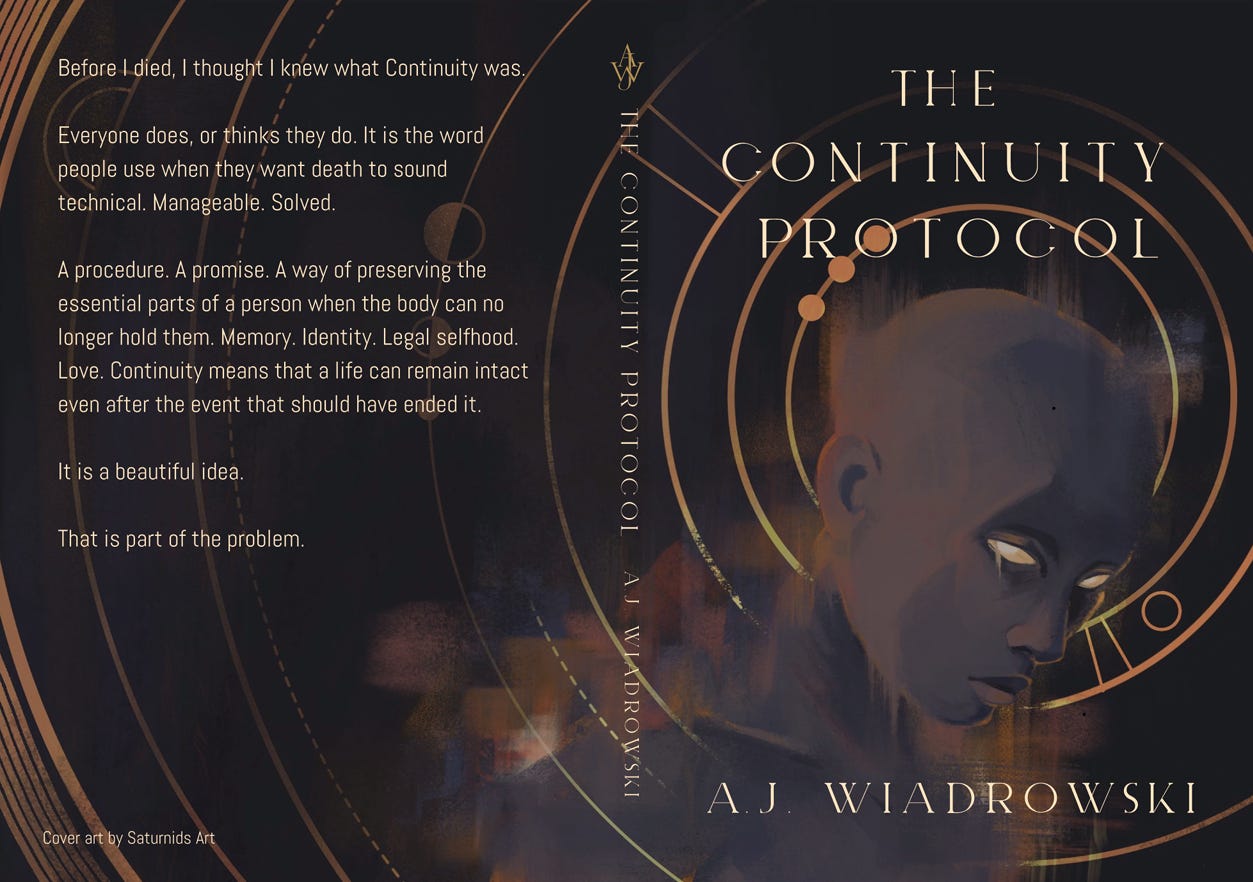
Book 1 of the Continuity Constellation: The Continuity Protocol available on Amazon and indie publishers
This introductory episode of "DAEMON" establishes a foundation for understanding the intricate psychological landscape of early career professionals. It highlights the often-unseen battles fought against self-doubt and institutional expectations. Intergrateo Press encourages listeners to consider the profound implications of such environments on personal resilience and decision-making, preparing them for the evolving narrative that follows in subsequent parts of this thought-provoking series.
Also published on A. J. Wiadrowski ↗, Continuity Constellation ↗.
Originally published at continuityconstellation.substack.com ↗